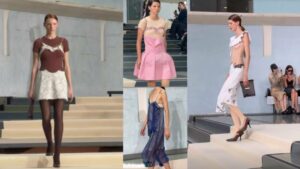
The show opened with singular silhouettes, veiled behind titanic glasses vast portholes that evoked less elegance than the wreckage of a maritime market. Was it a castaway of fashion approaching us, crowned with a diver’s mask, or the House of Rabanne itself, drifting through the troubled waters where beauty’s dreams go astray?
Once, it dared bronze armors, draperies forged like meteors fallen from the sky. Today, it offers us nothing more than trinket necklaces, those glass tears that gleam without radiance, destined to be forgotten as soon as they have flickered.
The aesthetic wavered, undecided, between the scraps of a hardware store and the remnants of a naval arsenal, lacking the prophetic vision that once opened horizons of steel and stars. Some spectators, indulgent, claimed to see there the allegory of fashion itself submerged, struggling against the undertow of time. Others, harsher, perceived nothing but a grotesque parade a ready-to-wear weighed down by heaviness and vain irony.
Far from the metal dresses which, in the heroic years, seemed to clothe women with an as-yet unexplored future, this 2026 collection resembles a Saturnalia of bad taste, where imagination drowns in the stagnant waters of vulgar chrome. Critics, divided between laughter and sighs, nonetheless bowed to one merit: Paco Rabanne knew how to capture attention. But to please? For that, like the stifled diver, one must resurface and breathe pure air once again where art regains its grandeur and fashion its immortal reason for being.

Fendi has made its choice sorry, the Lord has spoken and it is Maria Grazia Chiuri who takes over the artistic direction of the Roman house. This appointment comes in the midst of a chaotic reshuffle: Kim Jones’s departure, once expected to embody the creative breath of both haute couture and ready-to-wear, has left a void that Fendi is now scrambling to fill. Silvia Venturini Fendi, meanwhile, has been asked to step back, relegated to the more symbolic role of honorary president but given her last collection, this hardly comes as a surprise.
Big bows and old lace that’s about as faithful a summary as you can get of Nicolas Guesquière’s latest show for Vuitton. The staging is as stable as a Windows 98 system on life support, swinging between awkward hybrids and copy-pastes from Milan Fashion Week. You can tell the inspiration made a pit stop at Malpensa before taking off.
This collection was born from a secret oath between the splendor of yesterday and the vigor of today (says the designer). From the magnificence of the French court, she borrowed grandeur, brocades, solemn braids, and radiant crosses; but instead of letting them slumber in the dust of palaces, she set them against the wild momentum of our century, so that they might clash and fertilize one another in a dazzling embrace.


On Wednesday in Milan, Silvia Venturini Fendi unveiled a motley collection for Fendi, bursting with flowers and references to the 1990s. The exercise is clever: taking what, until yesterday, was considered “cheap” elastic cords, adjustable straps, flimsy windbreaker zippers and elevating it to the status of a new chic ornament on Calais lace “made in China.” Luxury has always loved recycling the banal since the man from Toledo, provided it’s wrapped in a carefully crafted narrative and staged with theatrical flair. It was as if we were laying the first stone of a memorial dedicated to the victims of stoning.
Summer not the heatwave one, but the world’s summer that clings to old Britpop rags. Shabby tracksuits and drooping polos with fishtail parkas dragging through the mud like the Gallaghers, priests of nothing and celebrants of noise…
To convey the full “Gucci spirit,” Demna imagined a series of characters gathered under the name “La Famiglia,” each with their own personality and distinctive attitude. In collaboration with Francesca Bellettini, the newly appointed president and CEO, the designer chose to unveil a look book photographed by Catherine Opie on Monday, ahead of the short film The Tiger, directed by Spike Jonze and Halina Reijn, which will be presented Tuesday evening in Milan.
What a vile farce, what a grandiose comedy this televised mass for that Maga YouTuber, this liturgy of a stuffed corpse in global broadcast! They shower him with incense, they weep like hysterical church ladies before the coffin of a cardboard prophet, a racist antisemite disguised as a universal martyr! We are force-fed with violins and rancid speeches, as if the sanctified carrion could wash away our collective sins!
Enough! Let us put an end to this travesty of style’s History, dressed up only to amuse the fashionable gallery. Gothic was not born in some backroom of Central Saint Martins between two Instagram selfies and a sponsored “rebellious” performance. No: it was conceived, forged, and imposed on fashion by Jean-Luc Amsler. Full stop.
Kering seems to have found the miracle cure for all its problems: changing (yet again) the CEO at Gucci. After nine months in the role, Stefano Cantino—barely the length of a maternity leave or two fashion seasons—has already been shown the door. Apparently, in luxury, instability is the new must-have accessory.
So here we are, presented with yet another temple of luxury, erected like a manifesto of ostentatious grandeur, with its seven levels piled up like the vanities of a world already overfed. A design gallery, two culinary spaces, an interior studio… it reads like a catalog of desires packaged in marble and glass. Paris, once again summoned as a postcard backdrop, finds itself ordered to host this transatlantic hybrid: half American dream bunker, half French palace of illusions.
The zipper, commonly called a zip, is today an everyday object, found on jeans, bags, coats, or even shoes. It is so widespread that we almost forget it was the result of a patient invention, the fruit of several attempts before becoming established.


Luxury industry entrepreneur and investor Francesco Trapani has passed away in Rome at the age of 68. The son of Lia Bulgari and nephew of Gianni, Paolo and Nicola Bulgari, he had, according to the statement, “inherited a profound passion for excellence, creativity and innovation.”
The US Open! This tournament, supposed to be the pinnacle of sport, the embodiment of merit, sweat, self-sacrifice, those hours of solitude on the court and training, that merciless discipline that makes an athlete a champion. And what are we being sold in endless glossy columns and sponsored Instagram posts? Certainly not the sporting achievement, but the pathetic parade of a “court of mirages”: Botoxed stars, supermarket bimbos, silicone clones, and interchangeable influencers whose only contribution to humanity is a plastic smile and a promo code for a pair of sneakers mass-produced by children.